Most gay men in western North Carolina have spent a significant portion of their lives being very careful. Not dramatic-careful. Quiet-careful. The kind that becomes automatic.
That carefulness has a specific origin in this region. The Southern evangelical church didn't just disapprove of gay identity. It organized community life around the disapproval. If you grew up here, you likely didn't just fear being gay. You feared being discovered. Two things. The distinction matters because the second one doesn't dissolve when you come out. It keeps running. It shapes how you talk in certain rooms, what you disclose to family, whether you ever stop monitoring yourself in settings that feel vaguely familiar to those early ones.
A life coach for gay men in Asheville recognizes the carefulness as a trained response. And training can be examined.
What coaching actually does is not what most people imagine it does. The image is a therapist's office with an optimistic aesthetic. Someone asking how that makes you feel. Homework about journaling. That's not this. Coaching starts with where you are and moves toward where you want to be. It isn't retrospective by design. There's no diagnosis, no treatment, no clinical framework. The orientation is practical: what are you doing with your time, your relationships, your sense of who you are, and what do you want to be doing differently. The first session is mostly me listening and asking questions that don't have obvious answers. Not profound-sounding questions. Operational ones. What would a good six months look like. Where are you spending energy that isn't going anywhere. What decision have you been circling for longer than makes sense.
Most gay men arrive expecting to be prodded about their feelings. What they get instead is someone taking their situation seriously as a practical problem. That's often a relief.
What they get instead is someone taking their situation seriously as a practical problem.
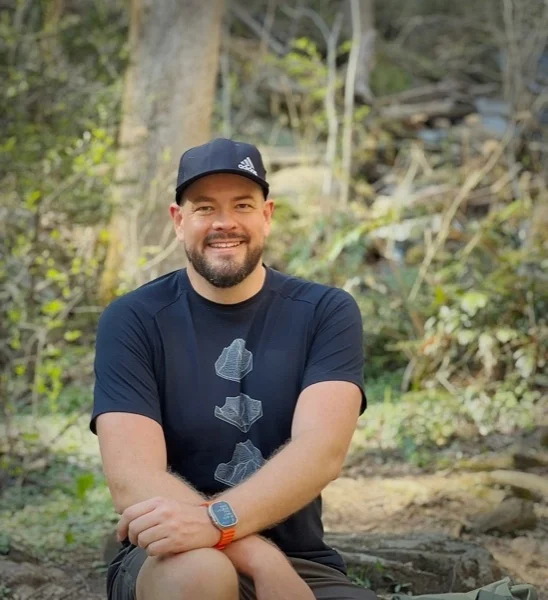
The walk-and-talk option exists because this is Asheville and the trails are there, and because some men think better when they're moving. The Bent Creek area, the North Mills River loop, sections of the Mountains-to-Sea Trail inside the Pisgah: these are not dramatic choices. They're quiet, reliable, and require nothing other than showing up in shoes you can walk in. Some clients prefer it consistently. Some prefer it some days and not others. A format that works for people who'd rather talk side-by-side than face-to-face, who find the environment settling rather than distracting.
Gay men, in particular, often resist asking for support for a long time. The reasons are structural. Many were taught that needing help was weakness, and many received that lesson twice: once from the broader masculine culture they grew up in, and once from religious environments that framed their sexuality itself as a need they shouldn't have. The result is a particular kind of self-sufficiency. Capable, often high-functioning, and quietly exhausted by managing everything internally. The man who arrives at coaching has usually been thinking about it for months or longer. He's already got his own handle on most of what's happening. He's come because the understanding he has isn't producing traction.
That's the most common entry point: not confusion, but stuck. Clarity without movement. Knowing exactly what the situation is and being unable to shift it.
Queer coaching is built specifically for this, and geography shapes it more than most people expect. Coaching for gay men coming out later in life in Boston or Los Angeles looks different from the same work in WNC. The cultural backdrop is different. The family system is different. The religious history is often different. A man who grew up evangelical in Hendersonville and came out at 42 is carrying things that require familiarity with that specific formation. Generic affirmation doesn't reach it. Neither does coaching that treats gay identity as a settled starting point rather than something that took serious cost to arrive at.
Coming out later in life, specifically, produces a set of conditions that don't get named accurately. There's often grief that doesn't have an obvious object. Loss for time, for a version of a marriage or a family structure, for the self you might have been. There's also the practical reality of building a social life as an adult gay man when you skipped the developmental stretch where most people figure out who they are in that context. Mid-life, queer, and socially starting over is a specific situation. It calls for specific work.
What coaching looks like over time is less tidy than what it looks like in the first session. It isn't a straight line. Some weeks the conversation is focused and productive and you leave with clarity. Some weeks the clarity is that the thing you thought was the problem isn't the problem. Both are useful. The work is iterative, not linear, and it doesn't follow a program. Every man who comes to this work is carrying something in a particular configuration, and the configuration matters more than the category.
The work isn't about arriving at a destination. The single truest thing about coaching is that it gives you someone on the outside of your own head who takes what you're carrying seriously enough to push back on it.