Most people searching for a life transitions coach in North Carolina are not looking for help pivoting their career or optimizing their morning routine. They're in the middle of something harder. Something that doesn't have a name in the self-help aisle.
They came out at 43. They walked away from the church that raised them and now can't locate themselves in the absence. They built their whole identity around a version of manhood that stopped working. Their marriage ended and they realized they'd been a stranger in it for years. These aren't logistical problems. They're identity problems. And that's a different animal.
Standard life coaching was built for people who know who they are and want to get more of it. Set the goal, build the system, execute the plan. That model is genuinely useful when the problem is focus or momentum or accountability. It does not work when the problem is that you no longer recognize the person you're supposed to be executing for.
That's what makes these transitions different. Research published in Psychiatry Research found that people who experienced a loss of social identities as a result of a stressor had a subsequent decline in wellbeing. The harm isn't just from the stress itself. It's from the identity that doesn't survive it. Coming out doesn't just change your relationship status. Leaving a religion doesn't just change your Sunday mornings. Unlearning a way of being a man doesn't just change how you talk. Each of these collapses something structural. The scaffolding you used to know yourself by.
Therapy is one response to that kind of collapse. A good therapist can do work that a coach cannot and should not try to replicate. But therapy and coaching aren't interchangeable. They're different relationships with different purposes. A therapist is trained to treat; a coach is trained to move. Some people need both. Some people are ready for one and not the other. What matters is being clear about which one you're in.
A therapist is trained to treat; a coach is trained to move.
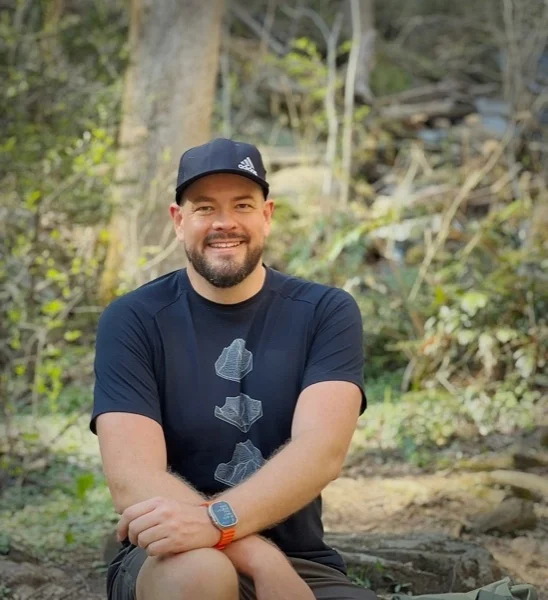
What I do as a coach is work with people who are past the acute crisis and into the fog. The part where the worst is technically over but nothing makes sense yet. Where you've left the thing but haven't become the person who left it. That fog is real and it takes longer than anyone tells you. Having someone who has stood in that specific groundlessness (not a directory listing, not a clinician matching symptoms to categories) matters more than most people expect.
The transitions I work with most fall into a few overlapping categories. Men coming out later in life: the 38-year-old, the 51-year-old, the one who has been good at seeming fine. If you're looking for a coming out coach in North Carolina, what you probably need isn't someone who will celebrate you into comfort. You need someone who can sit with the specific grief of having lived a long time inside a shape that wasn't yours. People leaving high-control religion (ex-evangelical, ex-Mormon, ex-Catholic) who find that the frameworks they used to make sense of the world dissolved along with the belief. The religious trauma coach field is growing, but most of it is still either therapeutic (clinical) or testimonial (here's my story). What I offer is neither: it's a working relationship aimed at figuring out what comes next, not just naming what happened. Men working out what masculinity actually means to them, outside the version they inherited. That one is slower and stranger than people expect. And people navigating major relational shifts: ending a marriage, beginning ethical non-monogamy, rebuilding what intimacy looks like after all of the above.
A 2021 review in the Annual Review of Psychology identified multiple, maintained, new, and compatible group memberships as key determinants of how people adjust to significant life change. Translation: the people who come through these transitions with their footing are the ones who don't cut everything and also don't stay frozen in the old structures. They keep something. They build something new. They find people who can be with them in both. That's not a platitude. It's what the data shows, and it's what I watch happen in practice.
I work in Asheville and across Western North Carolina, which is not an accident. This is the Bible Belt South with mountains at its back and a strain of people who came here exactly because they needed somewhere to metabolize a major change. The region is thick with ex-evangelicals, queer transplants, men who got quiet in the mountains and started asking questions they'd deferred for twenty years. A life coach in Asheville, NC working in this specific lane doesn't need to explain the context to clients. Most of them are already swimming in it.
If you're in identity transition coaching territory (not "I want a better job" but "I don't know who I am anymore"), the first conversation is just a conversation. No intake form longer than a paragraph, no commitment, no pitch. We figure out together whether this is the right fit.
The fog doesn't last forever. It just lasts longer than everyone said it would.