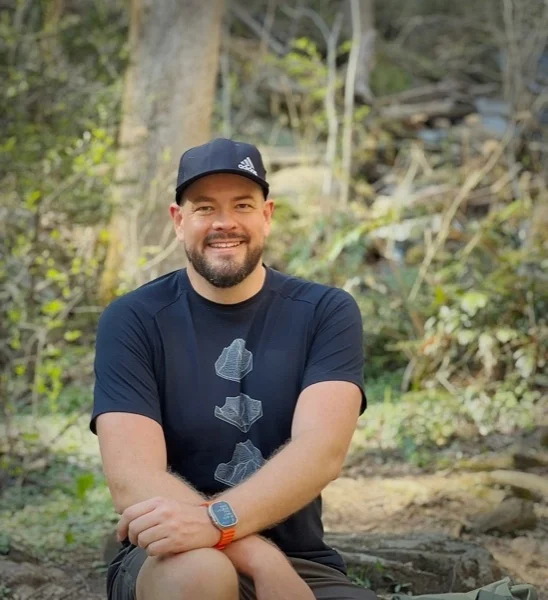
Search for polyamory in Asheville and you mostly get therapist directories: a grid of faces, rates, and bios about being sex-positive and non-judgmental. If what you want is a coach rather than a clinician, that's what I do. I'm Johann, I coach in Asheville and online, and polyamory and open relationships are a big part of my work.
I'm a coach, not a therapist. If you're in crisis, or old trauma is running the show, see a therapist first. Most people who look for help with this are functional adults trying to change the shape of a relationship, often without words for what they want and with real fear underneath.
Before you pick anyone, work out how you got here. It changes what you need.
Which door you came in through
When Tatum and colleagues (2024) asked 63 people with polyamorous experience what first drew them in, the answers fell into four themes: their values, something in the relationship itself, an outside trigger, and sexuality. In my work, each door tends to get stuck in a different place.
- It fits what you believe about love. You're usually clear on why and stuck on how: pacing, agreements, a partner who isn't where you are yet. Most openings fail on speed, honesty debt, or both. More on opening up here.
- Something in the relationship pushed it. The marriage hit a wall, the sex stopped, someone met someone. The question to answer before you write a single agreement is whether opening up is a repair or an exit.
- Something outside cracked it open. A divorce, leaving the church, a move, a death. The poly question is riding on a bigger change. If you were raised to treat desire as dangerous, the old shame comes back the moment you want something. I've written about that collision.
- It's about who you are. You're queer, or coming out, or starting to suspect monogamy was never yours. That looks more like coming out than like a relationship experiment, and the hard part is trusting your own wanting. Start here.
Plenty of people have two of these at once. The loudest one is usually where to start.
Doing this in a small town
The complication is everything around Asheville. You can be out to your partners in West Asheville and still be one county over from a family and a church that know nothing about it.
Asheville is also small. The people you date will often share your friends or your workplace. Settle the privacy questions together before a chance meeting settles them for you:
- Who knows, by name, and who doesn't.
- What each of you says if you run into a partner's partner at work or with your parents.
- Whether you can be tagged in photos, and where.
- Whether family is "not yet" or "never", and who gets to decide when that changes.
You're also less unusual than it feels. In a national sample of 3,438 single US adults, about 1 in 6 said they wanted to try polyamory and about 1 in 9 had done it at some point.
What to ask a coach before you pay
- Ask whether they have a stake in where you land. Coaches who treat non-monogamy as the enlightened answer are selling something. Closing back up after an experiment that taught you what you needed to know is a fine result.
- Ask if they'll see you alone, together, or both. Openings often go better with both people in the room. Some things go better solo first.
- Ask whether they can work on the religion or coming-out side too. If either is tangled up in this, a coach who only knows agreements and calendars will miss half of it.
- Ask what they do when it turns out to need clinical care. You want someone who'll say so plainly.
How I work
I work with people coming in through any of those doors. The work is opening up, jealousy, coming out as poly, old shame about desire, and the endings and reshapes that need as much care as the openings. Solo or with partners, online from anywhere, or in person around Asheville, including walk-and-talk sessions on WNC trails. Sessions are $125 and the intro call is free. Here's how the coaching works.
If you're in Asheville or anywhere in WNC and you've been sitting on this for a while, the most useful thing I can tell you is that the waiting doesn't make it clearer.