Most men who end up looking for men's coaching in Asheville, NC weren't planning to move here to figure themselves out. That's just what happened.
They left something. A church that held their whole identity. A marriage that was also a life plan. A version of themselves that worked fine until it stopped working completely. Then, for a hundred different reasons, they ended up in Asheville. And now they're here, somewhere between what they were and whatever comes next, wondering if there's a faster way through it than just waiting.
There is. It's not magic. But it's not nothing, either.
The men I work with as a life coach for men in Asheville tend to fall into a few recognizable situations. Some are post-religious. They left an evangelical church, a high-control Mormon community, a Catholic upbringing that had a claim on every corner of their life, and now there's this strange open space where the certainty used to be. Some are navigating coming out later in life, usually in their late thirties or forties, sometimes with a marriage and kids and a whole constructed life that has to be renegotiated. Some are just standing in the wreckage of a decade that went sideways and trying to figure out who they are when none of the old reference points apply.
What connects them is the particular disorientation of being a man who built an identity on something that collapsed.
What connects them is the particular disorientation of being a man who built an identity on something that collapsed.
Religious trauma coaching for men tends to catch people who are surprised by how long the grief lasts. Leaving a high-control religion isn't just a theological shift. It rewires your social world, your relationship with your parents, your sense of what's permitted, your internal voice when you do something the church would have called a sin. Men who grew up in those environments often don't realize how much of their personality was assembled to survive them. Coaching gives you somewhere to think it through with someone who isn't going to tell you what to believe instead.
Queer men in Asheville, particularly men who came out after thirty, are navigating something specific: the feeling of being behind. Like everyone else got to practice being themselves for two decades and they're starting from scratch. That's not actually true, but it feels true. The work in that case is less about identity politics and more about excavating what you actually want, now that you're allowed to want it. Coming out is usually where the real questions start.
Research on men and help-seeking consistently finds that masculine socialization shapes both whether men seek support and how they do it. Addis and Mahalik, writing in American Psychologist (2003), found that approaches working with masculine identity rather than against it produce better engagement. Men who wouldn't walk into a therapy office will work through hard things in a context that feels active and forward-facing. That's not a trick. It's just accurate to how many men are built.
Asheville matters here more than just as an address. The city draws people who have already made one hard decision: to leave, to stop pretending, to start something new. That self-selection creates a particular kind of person: someone who knows something in their life needed to change and did something about it, even if they're not sure what comes next. Men who end up in coaching here are usually past the first act. They've already blown up the old structure. Now they're standing in the rubble figuring out what to build.
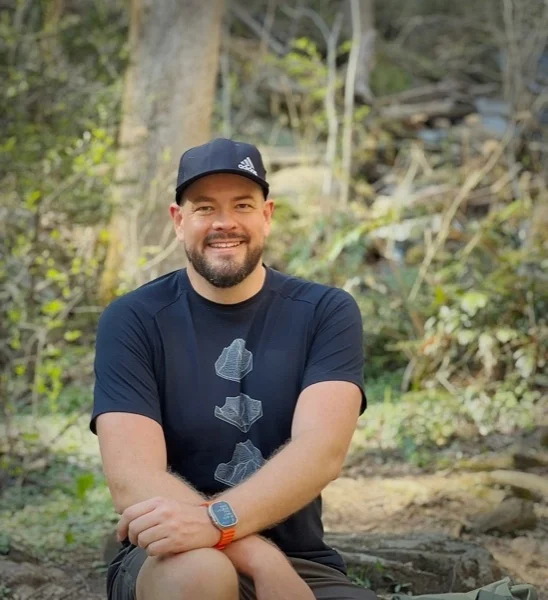
The work itself varies. Some of it is weekly one-on-one sessions, thinking out loud about identity and direction with someone who's paying close attention and not going to tell you what to think. Some of it is walk-and-talk sessions on the trails around here, which for a lot of men is the only format where they'll actually say the real thing. The Appalachian landscape is not incidental to that. There's something about being outside and moving that makes it easier for men to talk about the interior stuff. I've had men say more on a trail in forty minutes than they would in a year of sitting across from someone in an office.
A specific thread I work with in masculinity coaching is the question of what a man is supposed to be when he's thrown out the inherited answer. Most men got handed a model of masculinity that was about suppression, performance, and provision. When that model fails, or when the man himself decides it's not working, there's a gap. Not a void, but a genuinely open question. What does strength look like when you're not performing it? What do you want when you're not building toward someone else's idea of success? Those questions aren't rhetorical. They have answers. The answers just take some time to find.
Men come to Asheville because something is already over. Coaching is for figuring out what comes next.