Some men come out and feel lighter. The shame doesn't dissolve for everyone.
If you've been looking for coaching for gay men and you've already done some version of the work: therapy, coming out conversations, maybe years of private deconstruction. The thing underneath is still there, doing something specific. There's a reason for that. It isn't because you haven't tried hard enough. It isn't a personal failing you haven't named yet. It's that the shame you're carrying might not be the kind that self-work, on its own, can reach.
Most coaching for gay men is built around the idea that shame is a feeling. You feel bad about who you are. The work is to feel better. Affirmations, reframing, building confidence, learning to take up space. That's legitimate work. For a lot of men, it's the right work.
But some men's shame isn't a feeling. It's an architecture. It was laid down deliberately, systematically, by people with authority over them: parents, pastors, youth group leaders, entire communities organized around a theology that named who they were as a problem requiring correction. That isn't a wound in the ordinary sense. It's a worldview. And a worldview doesn't dissolve when you decide to believe something different. It runs underneath the belief, in the body, in the instincts, in the way a room full of certain people makes you smaller without your permission.
Purity culture did something specific to gay men who grew up inside it. It didn't just make sex feel dangerous. It made the self feel wrong. The body, the attraction, the way your eyes moved: all of it evidence of a defect that required constant management. You learned to monitor yourself in real time. You learned to perform a version of yourself that was acceptable. You got very good at both, and then you came out, and discovered the monitoring didn't stop just because you'd stopped agreeing with it. The shame wasn't about what you were doing. It was about what you were. That's the structural kind. That's what religious trauma actually looks like for gay men, and it runs deeper than most coaching frameworks are built to address.
Research by Meyer (1995) found that gay men experiencing high levels of minority stress were twice to three times as likely to suffer from high levels of distress, with each stressor (internalized homophobia, stigma, discrimination) showing an independent association with psychological outcomes. Independent. Meaning they stack. Meaning the man who grew up gay inside an evangelical household isn't just carrying internalized shame. He's carrying several distinct systems operating at once, each with its own weight.
What useful coaching looks like in this context is different from the confidence-building model. The work isn't reframing the shame. It's externalizing its source. That means naming, specifically, where it came from. Not as an intellectual exercise but as a repeated, practical act: that thought came from a particular system, installed by particular people, for particular reasons that had nothing to do with your wellbeing. The architecture was built by others. It can be examined. It can be questioned. It doesn't have to be the floor you stand on.
The work isn't reframing the shame. It's externalizing its source.
A 2023 study in SAGE Open Nursing by Cámara-Liebana et al. found that the gay identity formation process is "a key stage in the life trajectory of gay men, given the personal consequences, mainly in terms of the impact on their mental and social health." Men moving through it reported feeling "different and alone" and needed support during the process. The need for support during formation is the research finding. Not after. During.
This kind of queer men identity coaching is specifically for the man who has already started. He's out, or close to it. He knows what's true about himself. But he's still running the old operating system in the background, and it's costing him: in relationships, in work, in the specific exhaustion of never quite being off-guard. It's for the man coming out later in life who spent decades building a career, a social circle, maybe a marriage, around a version of himself that was real in every way except the most basic one. Unpacking that isn't about becoming someone new. It's about figuring out who was actually there the whole time.
It isn't for someone in acute crisis. That's therapy's territory, and that distinction matters. It isn't for the man who had a secular upbringing and wants tools to be more confident in gay spaces. Those are different problems and there are coaches well-suited to them.
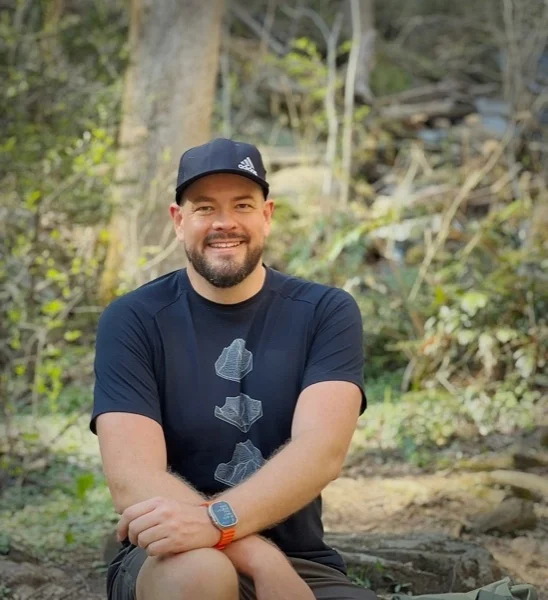
Johann works as a life coach with gay men in Asheville, North Carolina: in person, walk-and-talk through the WNC hills, and online. If the coaching for gay men you've been looking for has religion in the background, that's the specific work he does.
The architecture can be examined. That's where it starts.